The Short Answer You Came For
Here’s what you actually want to know: grab your smartphone, turn the screen brightness to max, hold your sunglasses about six inches away, and slowly rotate them to a 90-degree angle. If the screen goes noticeably dark—or completely black—congratulations, you’re holding a pair of polarized sunglasses. If nothing changes, what you have is essentially a pair of tinted plastic discs that dim everything equally without actually cutting the glare. This LCD screen trick works because most modern displays emit polarized light, and two polarizing filters stacked at opposing angles cancel each other out. It’s physics doing you a solid.
But here’s the thing nobody tells you: dark tint does not equal polarization. I’ve seen people spend good money on shades that look the part but perform like dollar-store props. So let’s get into the real ways to separate genuine glare-killers from the impostors.
Why You Should Care About Polarized Lenses in the First Place
Before we run through the tests, let’s talk about why this matters beyond just satisfying your curiosity. Standard tinted sunglasses (there’s your one mention, carefully placed) reduce brightness by blocking a percentage of all incoming light. That’s it—they treat everything equally. Polarized lenses, on the other hand, specifically target horizontally oriented light waves—the ones responsible for blinding reflections off wet roads, car hoods, lake surfaces, and snow-covered slopes.
Physicist Liliane Ventura from the University of São Paulo describes it this way: polarized lenses reduce “the disruptive effects of glare,” making outdoor activities like driving, fishing, and skiing noticeably safer. Without polarization, you’re not just missing out on comfort—you’re potentially missing road hazards, underwater obstacles, or that patch of black ice hiding in plain sight.
Test #1: The LCD Screen Method
This is the gold standard, and you probably already have everything you need within arm’s reach right now.
What you’ll need: A smartphone, tablet, laptop, or any device with an LCD screen. (Note: OLED screens work differently, so stick with an older LCD if possible.)
Step-by-step:
-
Turn your device’s brightness up to maximum and pull up a white or brightly colored background.
-
Hold your sunglasses about 6-8 inches in front of the screen.
-
Look through one lens at the screen, then slowly rotate the glasses from horizontal to vertical (about a 90-degree turn).
What to expect with genuine polarized lenses: The screen will appear to darken progressively as you rotate. At the 90-degree mark, many polarized lenses will make the screen look nearly black. Some cheaper polarized lenses might just show a subtle wave pattern or faint darkening—but there should be a noticeable change.
What if nothing happens? Then your lenses aren’t polarized. Simple as that.
A quick heads-up: this test works because LCD screens themselves emit polarized light. When your lens’s polarizing filter aligns perpendicular to the screen’s filter, light gets blocked. It’s the same reason why looking at your phone through polarized lenses sometimes creates those weird rainbow patterns.
Test #2: The Real-World Glare Check
This one’s less technical but arguably more practical—it tells you whether your lenses actually deliver in the conditions they’re designed for.
Find a reflective surface—a car windshield on a sunny day, a puddle after rain, a shiny tabletop, or ideally a body of water if you’re near one. Put your glasses on and look at the glare bouncing off that surface. Tilt your head slowly from side to side, about 60 degrees in each direction.
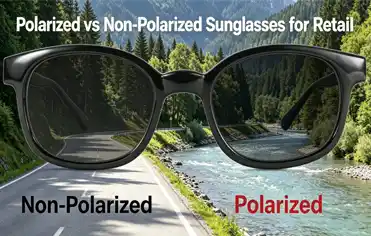
With polarized lenses, you’ll see the glare visibly brighten and dim as you tilt. At certain angles, the reflection will practically disappear, revealing details underneath—like the actual texture of the road or the fish swimming below the water’s surface.
With non-polarized tinted lenses, Everything just gets uniformly darker. The glare stays right where it is, just slightly dimmer. You’re not eliminating the visual noise; you’re just turning down the volume on everything equally.
Here’s a real-world scenario: I once tested this while driving eastbound on a highway at 4 PM in summer. The glare bouncing off the asphalt was so intense I could barely see the lane markings. Switched to a polarized pair I had in the glove compartment—the difference was immediate. The road didn’t just get darker; it became readable again. That’s the kind of moment when you stop questioning whether polarization matters.
Test #3: The Two-Pair Overlap Method
This one requires access to at least one pair that you already know is polarized—maybe a friend’s pair, an older pair you’ve verified, or a store demo.
How it works: Hold the known polarized pair in front of your eyes (or against a light source). Then take the pair you’re testing and hold it in front of the first pair, so you’re looking through both sets of lenses. Rotate the test pair to a 90-degree angle relative to the known pair.
If both are polarized, the overlapping area will turn very dark, often completely black. This happens because the two polarizing filters are now oriented perpendicular to each other, blocking nearly all light from passing through.
If only one is polarized or neither is, you’ll still be able to see through the overlapped lenses fairly clearly. No dramatic darkening effect.
This is essentially the same principle as the LCD test, just using another polarized lens as your light source instead of a screen. It’s particularly useful if you’re shopping in person and the store has a polarized demo lens available.
The UV Protection Blind Spot (Most People Miss This)
Here’s something that trips up a lot of buyers: polarized does not automatically mean UV-protected. I’ve seen this misconception everywhere, and it’s dangerous.
According to Harvard Health, polarized lenses alone do nothing to block ultraviolet radiation. That requires a separate UV treatment. In fact, a recent study by Ventura’s team found that the majority of sunglass lenses tested inadequately filtered harmful UV radiation, leaving eyes susceptible to long-term injuries like cataracts and even ocular cancer.
So when you’re evaluating a pair, check the label for UV400 or 100% UV protection. That’s the non-negotiable baseline. Polarization is the bonus feature that makes your outdoor experience comfortable; UV protection is the safety feature that keeps your eyes healthy for decades.
Think of it this way: UV protection is the seatbelt. Polarization is the heated seats. You want both, but one is clearly more important than the other.
When Polarized Lenses Might Not Be the Best Choice
Let me be honest—polarized lenses aren’t perfect for every situation. Transparency builds trust, right?
Looking at LCD screens can be tricky through polarized lenses. Your car’s dashboard display, GPS unit, or smartphone might appear dim or even black at certain angles. Most modern devices compensate for this, but older models can be problematic.
Winter driving on ice presents a genuine safety concern. The reflections that help you spot black ice patches can get filtered out by polarized lenses, making hazardous conditions harder to detect. The American Academy of Ophthalmology notes that this is a legitimate drawback to consider if you live in snowy climates.
Night driving is another no-go. Polarized lenses reduce overall light transmission, which is the opposite of what you want when visibility is already compromised.
So no, polarized lenses aren’t an “always and everywhere” solution. But for bright daytime conditions—driving, fishing, beach days, skiing, hiking, or just walking around a sun-drenched city—they’re genuinely transformative.
Finding Quality Anti-Glare Eyewear That Actually Delivers
If you’ve run through these tests and realized your current pair is falling short, you’re not alone. The good news is that reliable polarized eyewear is more accessible than ever, but you still need to know where to look.
Check the product description for explicit mentions of polarization and UV400 certification. Avoid vague marketing language like “glare-reducing” without the actual “polarized” specification.
Read user reviews with an eye for specific performance claims. Real buyers will mention whether they noticed glare reduction while driving or fishing.
Test before you commit whenever possible. The LCD screen test works just as well on a store display as it does at home.
If you’re shopping online and want to explore options that combine genuine polarization with full UV protection, check out the curated collection at explore polarized options. You can browse different frame styles and lens configurations that fit your specific outdoor needs.
The Bottom Line
You don’t need an optics degree or expensive equipment to tell if your eyewear is polarized. One smartphone, one reflective surface, or one known polarized pair is all it takes. The LCD screen test is your most reliable ally—if the screen goes dark when you rotate your glasses, you’re good to go.
But remember: polarization solves glare, not UV exposure. Always verify that your sunglasses (second mention, still counting) offer UV400 protection regardless of their polarization status. And consider your use case—what works brilliantly for a fishing trip might not be ideal for winter mountain driving.
Your eyes deal with a lot every single day. Cutting through the visual noise isn’t just about comfort; it’s about seeing the world the way it’s meant to be seen. And once you’ve experienced genuine polarization in bright conditions, going back to standard tinted sunglasses (third and final mention) feels like trying to watch a movie with a dirty lens.