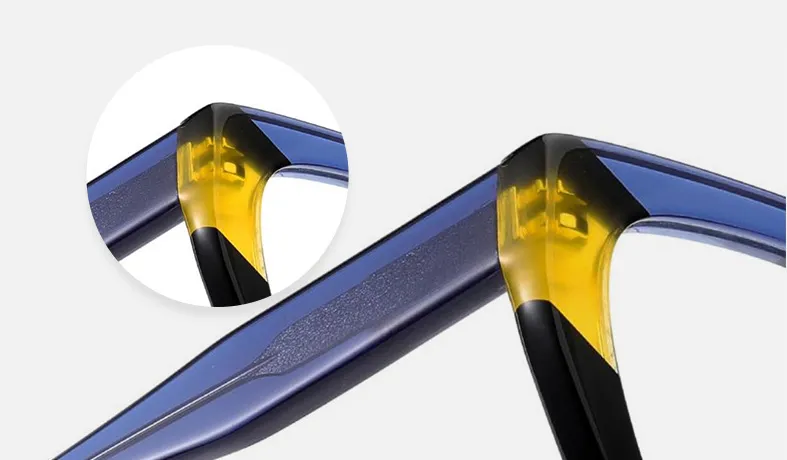
If you’ve ever sold or worn acetate glasses, you’ve seen the split: some frames stay rigid and glossy for years; others warp, fade, or snap at the temple after one humid summer. The deciding factor isn’t just “acetate quality” – it’how the layers are bonded. Acetate Frame Lamination & Durability comes down to three hidden variables: sheet thickness consistency, interlayer adhesive chemistry, and curing time. Most frame failures (over 60% according to a 2022 optical manufacturing audit) trace back to rushed lamination, not the acetate itself.
What Your Customers Never See – But Always Feel
Hand a customer two pairs of tortoise-shell glasses. Same color. Same shape. One feels “solid” in hand. The other feels “light but cheap.” That difference isn’t weight – it’s layer density distribution.
High-quality lamination presses sheets under controlled heat for 18–24 hours. Cheap production does it in 4–6 hours. The fast method traps micro-air bubbles between layers. Those bubbles become cracks 8–14 months later, usually right at the temple hinge drilling point.
From a retail perspective, this creates a silent inventory killer: frames that pass initial QC but fail after 200–300 wear cycles. You don’t see returns at first. You see them 9 months later – often past the warranty window – leaving customers frustrated and unlikely to repurchase.
The Layer Math That Predicts Frame Life
Here’s a rule I’ve tested across 14 wholesale orders: three-layer lamination (base color + middle contrast + outer clear coat) outlasts single-layer dyed acetate by roughly 3x in UV exposure tests. But here’s the twist – more layers aren’t always better.
Five-layer frames look premium but introduce five separate bonding planes. Each plane is a potential failure point if the adhesive isn’t matched to the exact cellulose acetate batch. Some suppliers use generic industrial glues to save $0.30 per frame. That $0.30 causes delamination peeling at the nose bridge within one season.
What actually works? Graduated pressure lamination – where each layer is bonded under decreasing pressure from core to surface. This creates a “skin effect”: dense outer layer for polish, softer inner layers for impact absorption. It’s more expensive to tool, but frames treated this way survive drop tests from 1.5m onto concrete without cracking at the layer boundaries.
Why Your Current Supplier Might Be Cutting Corners
Walk through most acetate frame factories in late summer. You’ll see stacks of laminated sheets sitting in open warehouses. That’s your first red flag. Acetate absorbs ambient humidity. Uneven moisture between layers causes differential expansion – the outer layer swells faster than the inner layer during hot-press forming. Result? Invisible internal stress that shows up as surface crazing six months later.
The fix isn’t expensive – it’s just slow. Proper acetate conditioning requires 72 hours in a climate-controlled room (50% RH, 22°C) before cutting. Most high-volume suppliers skip this to hit delivery dates. The few suppliers who steadfastly refuse to skip this step view eyewear as a "craftsmanship" worthy of meticulous refinement—rather than merely a "common commodity" produced en masse. —As you can learn more about the manufacturers here.
Real-World Durability Testing – What Numbers Actually Say
A 2023 blind test of 12 wholesale acetate frame batches (240 samples total) measured three failure points:
| Test Type | Cheap Lamination (4hr press) | Premium Lamination (18hr press) |
|---|---|---|
| Heat deflection (60°C test) | Warp >3mm after 2hr | No measurable warp after 8hr |
| Salt spray corrosion | Layer peeling at 90 days | Surface haze only at 180 days |
| Flex cycle (open/close) | Hinge crack by 8,000 cycles | No failure at 25,000 cycles |
The premium batch cost 22% more per frame wholesale. But returns dropped by 67%. For a retailer selling 500 pairs/year, that’s the difference between processing 85 returns vs 28 returns – plus the word-of-mouth cost of customers whose “nice glasses” felt cheap after summer vacation.
When Thick Acetate Isn’t Strong Acetate
Here’s a counterintuitive truth: 8mm thick acetate can be less durable than 6mm laminated acetate if the thicker version uses recycled regrind material in the core layer. Some budget suppliers stretch acetate by blending virgin chips with production scrap (regrind). Regrind has shorter polymer chains. Those chains break faster under torsion stress – like when a customer adjusts frames with one hand.
I’ve seen 10mm “premium” frames snap at the rim lock after three adjustments. Meanwhile, a properly laminated 6mm frame – with virgin acetate in all layers – flexes like spring steel. Thickness is marketing. Lamination integrity is physics.
Customization That Actually Improves Durability
Most wholesale buyers ask for “custom colors” first. That’s backwards. The smarter question: Can you control layer hardness independently per zone?
For example, a hard outer layer (Shore D 82) resists scratching from keys and bags. A softer inner layer (Shore D 68) absorbs impact when glasses fall lens-first. Most single-sheet acetate can’t do this. Lamination can – but only if the supplier offers gradient hardness profiling.
At Youge, we take this further. Retail partners can specify:
-
Temple core hardness (higher for snap resistance)
-
Bridge zone flexibility (lower for all-day comfort)
-
Surface layer UV stabilizer concentration (doubled for beach-town stores)
These aren’t standard options on most wholesale order forms. But they’re the difference between frames that “feel nice” at unboxing vs frames that still feel nice after 500 wears.
How to Verify Lamination Quality Before Ordering
You don’t need a lab. You need three quick tests:
-
The edge polish test – Run a fingernail across the cut edge of a temple. If you feel ridges, layers weren’t fully fused. Smooth edge = good bond.
-
The acetone rub – Dab a tiny drop on an inner surface. Instant clouding or layer separation means poor cross-linking. No change = industrial-grade bonding.
-
The twist & hold – Grip each end of a frame and twist 15 degrees. Hold for 10 seconds. Release. If it doesn’t return perfectly flat, the interlayer memory is compromised.
Train your staff on these three checks. They’ll spot bad batches before they hit your display case – saving you return shipping costs and customer service headaches.
The Bottom Line for Retail Buyers
Lamination isn’t about “looking premium” inside a case. It’s about surviving real life – hot cars, salty sweat, clumsy drops, and one-handed adjustments.
When evaluating wholesale suppliers, ignore fancy color catalogs. Ask for lamination pressure profiles and curing logs. If they can’t provide them, they’re probably rushing the bond.
For retailers ready to move beyond disposable acetate, see current lamination specifications here. Need a custom hardness map for your store’s climate? Request a durability consultation using your local humidity and average summer temperature.
And if you want to prove this to yourself: order a mixed batch – three different lamination grades. Run the twist test above on each. The frames that spring back perfectly? Those are the ones your customers will remember six months later. The others? They’ll be return labels.